
By Daniel Harper
Digital Safety Editor
Aug 16, 2025
Advanced Sudoku Deduction Tutorial: For Seniors
Introduction: From Basics to Mastery
Sudoku, as a logic puzzle, has gained popularity among millions of enthusiasts worldwide, especially for the elderly population who require continuous mental exercise. When the difficulty level jumps from beginner and intermediate to advanced or "Super Fiendish," relying solely on basic number searching and Direct Solves will quickly hit a wall. At this point, Sudoku is no longer a simple number game but evolves into a science involving abstract logic and pattern recognition.
Solving advanced Sudoku requires mastery of a systematic set of "Deductions" techniques. Many solvers might feel frustrated or tempted to guess when attempting high-difficulty puzzles. However, the crucial premise to understand is: all Sudoku puzzles published by reliable sources, including the "Super Fiendish" level introduced by The Times, are always solvable purely through logical deduction, without the need for guessing. This firm belief is the psychological cornerstone for continuing to learn and master advanced techniques. Guessing is not only the root of failure but also destroys all subsequent rigorous logical deductions, which is particularly important for elderly learners who need to maintain precise logical processes.
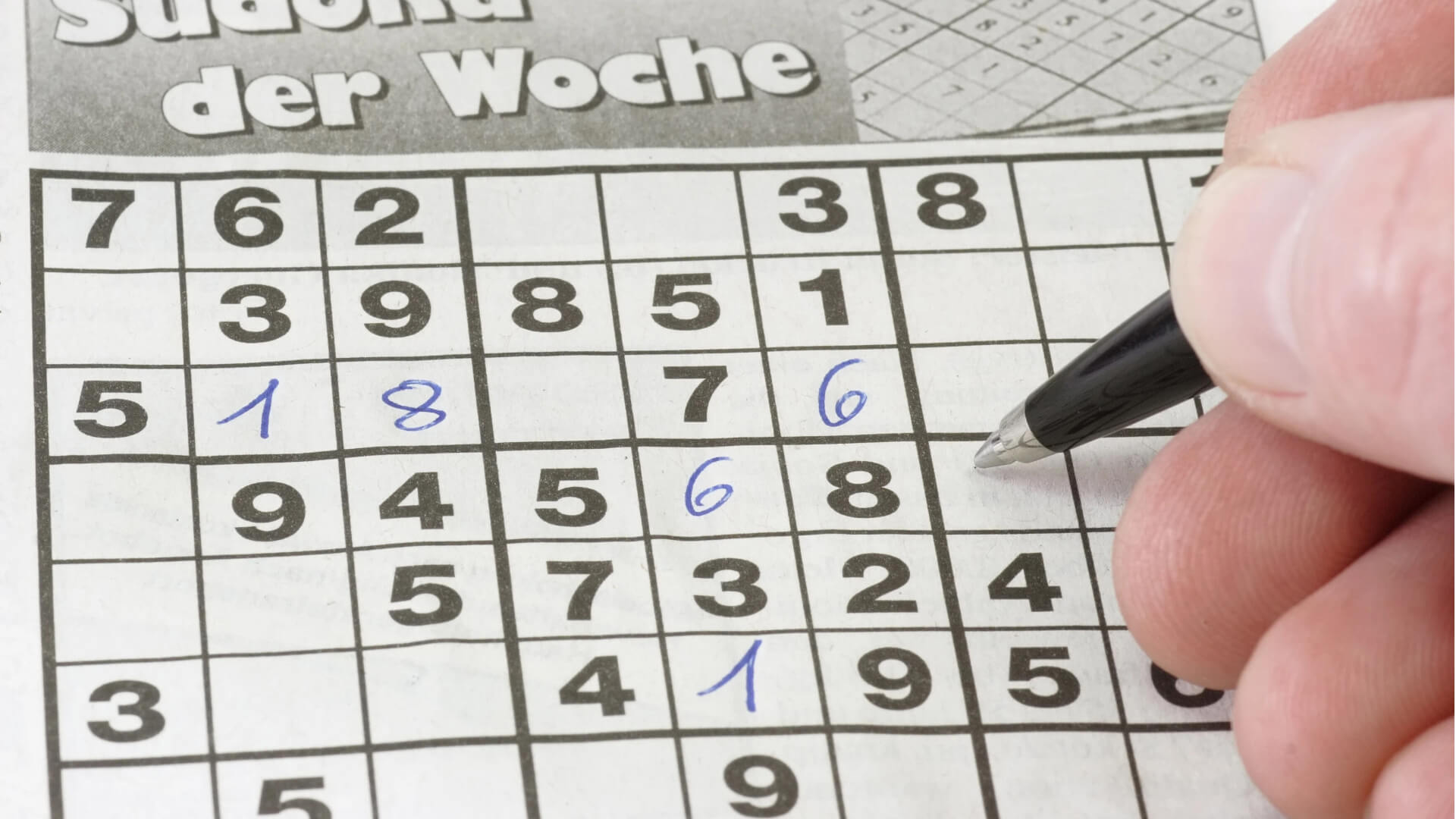
The Two Stages of Sudoku Solving: Direct Solves and Deductions
The Sudoku solving process can be clearly divided into two main stages, marking the evolution of the solving mindset from simple to complex.
Stage I: Direct Solves Direct Solves refer to methods where a cell's value can be determined immediately, such as by observing constraints in rows, columns, and blocks, determining that only a specific number can be placed there. In these simple techniques, the placement of the number is obvious, such as Naked Singles or Hidden Singles. In fact, all easy-level Sudoku puzzles can be completed using only Direct Solves.
Stage II: Deductions When Direct Solves reach a bottleneck, Deductions come into play. Deductions do not immediately determine a cell's value; instead, they eliminate candidates from cells by analyzing relationships and patterns across the entire grid. The core principle of Deductions is: if a specific digit must be placed within a certain set of cells, it can be eliminated from all other cells in that group.
Core Deduction Techniques: From Beginner to Advanced
Technique 1: Naked Pairs/Triples/Quads

Concept: When two (or three or four) cells in the same row, column, or block contain only the same two (or three or four) candidates, these candidates can be eliminated from all other cells in that group.
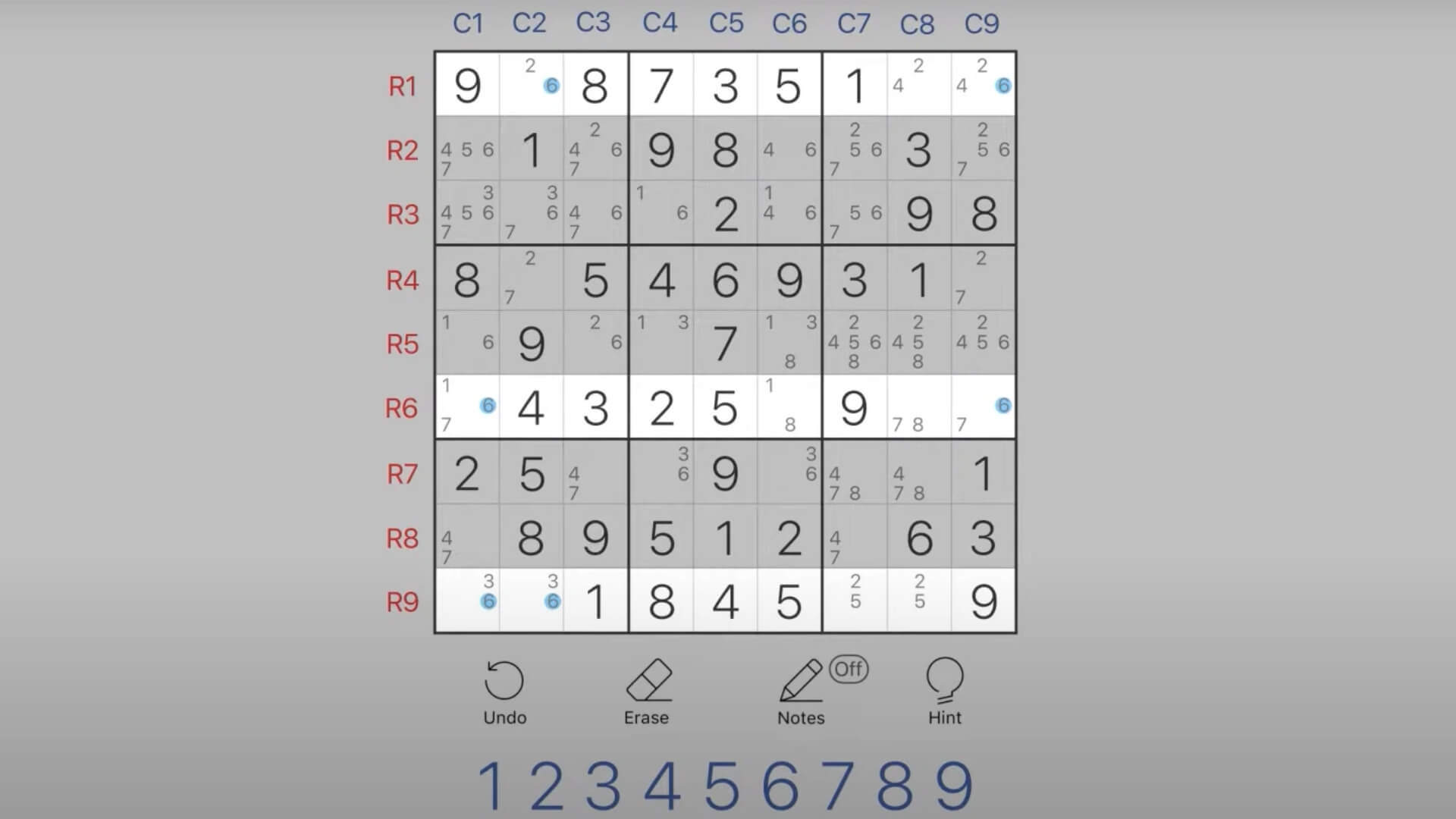
Example: If cells (2,3) and (2,7) in row 2 both have candidates {4,7}, then 4 and 7 must be in these two cells. Therefore, 4 and 7 can be removed from all other cells in row 2.
Key Insight: This technique relies on recognizing locked candidate sets. The more cells involved (pair < triple < quad), the more difficult it becomes to spot, but the elimination power increases accordingly.
Technique 2: Hidden Pairs/Triples/Quads
Concept: The inverse of Naked Pairs—when a set of candidates can only appear in a specific set of cells, those cells can have all other candidates removed.
Example: If in column 5, only cells (1,5) and (4,5) can contain the numbers 3 and 8, then these two cells must contain 3 and 8. All other candidates in these cells can be eliminated.
Key Insight: Hidden sets are harder to spot than Naked sets because the cells contain other candidates masking the relationship. Look for numbers that appear in very few cells within a group.
Technique 3: Pointing Pairs/Triples
Concept: When all candidates for a number in a block are confined to a single row or column, that number can be eliminated from the rest of that row or column outside the block.
Example: If in block 2, all candidate 5s are in row 2, then 5 cannot appear in row 2 outside of block 2.
Key Insight: This technique creates an effective elimination path across block boundaries. It's particularly useful for breaking through mid-level puzzles.
Technique 4: Box-Line Reduction
Concept: The reverse of Pointing Pairs—when all candidates for a number in a row or column are confined to a single block, that number can be eliminated from the rest of that block.
Example: If all candidate 7s in row 3 are located within block 1, then 7 cannot appear in any other cell in block 1.
Key Insight: This technique helps consolidate candidates within blocks, often revealing Naked or Hidden sets.
Technique 5: X-Wing
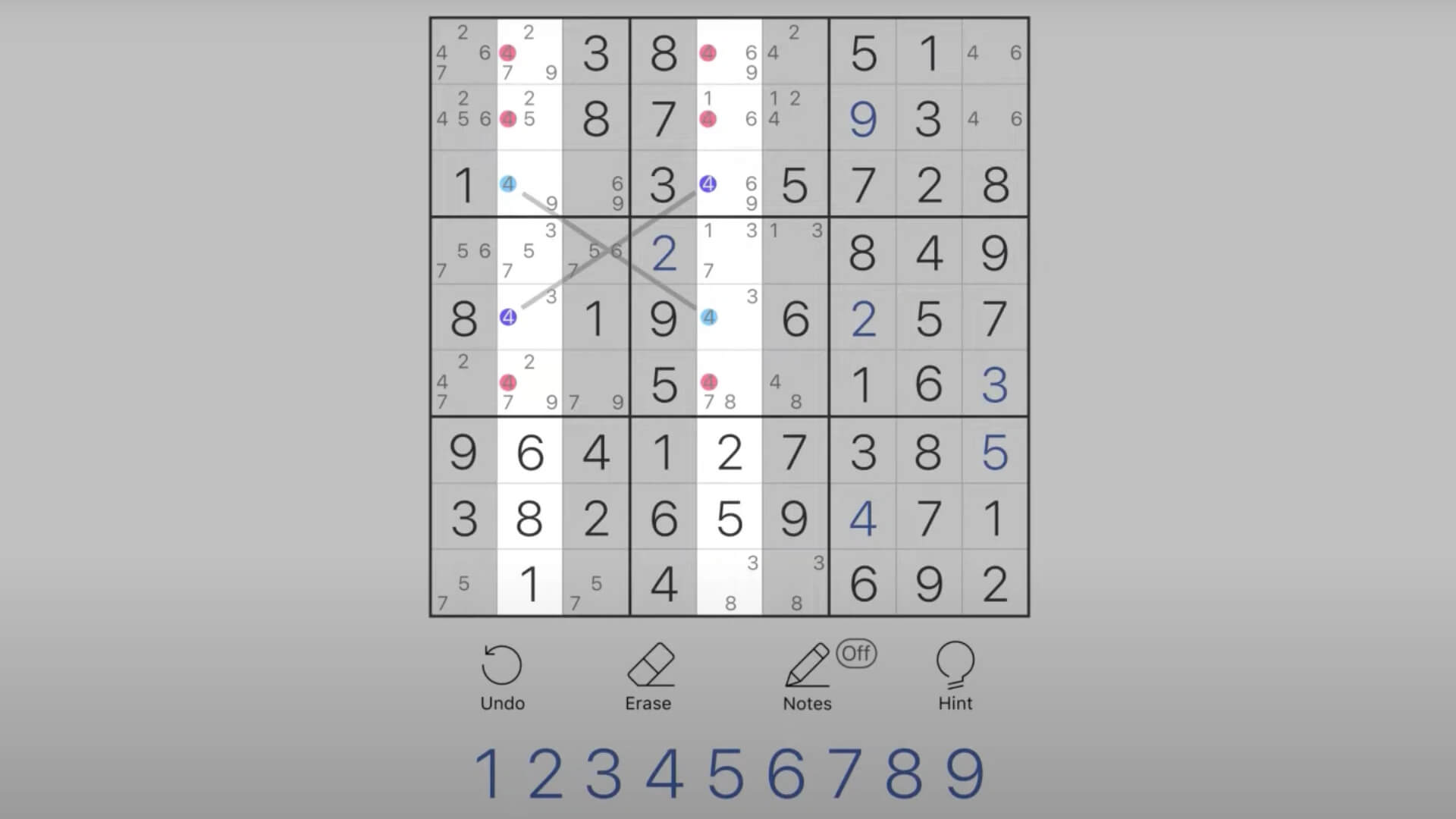
Concept: When a number has exactly two candidates in each of two different rows, and these candidates lie in the same two columns, the number can be eliminated from all other cells in those columns.
Example: If row 2 has 6s only in columns 3 and 7, and row 8 also has 6s only in columns 3 and 7, then 6 must be in (2,3) and (8,7) or (2,7) and (8,3). Therefore, 6 can be eliminated from all other cells in columns 3 and 7.
Key Insight: X-Wing forms a rectangle pattern. Look for this pattern by scanning rows and columns for numbers with exactly two candidates.
Technique 6: Swordfish
Concept: An extension of X-Wing involving three rows and three columns. When a number has candidates confined to three rows and three columns, forming a 3x3 grid, that number can be eliminated from all other cells in those columns.
Example: If rows 2, 5, and 7 each have candidate 3s only in columns 1, 4, and 6, then 3 must occupy one cell in each row/column intersection, allowing elimination of 3s from other cells in those columns.
Key Insight: Swordfish patterns are rarer and more complex than X-Wing. Focus on numbers with limited candidate positions across multiple rows.
Technique 7: XY-Chain
Concept: A chain of cells where each consecutive pair shares one candidate. If the first and last cells share a candidate, that candidate can be eliminated from any cell that sees both ends of the chain.
Example: Cell A has {1,2}, cell B has {2,3}, cell C has {3,1}. If A and C are in the same row, column, or block, then 1 can be eliminated from all cells seeing both A and C.
Key Insight: XY-Chains reveal relationships across distant cells. They're particularly powerful for solving advanced puzzles.
Solving Strategy: A Systematic Approach
Step 1: Complete All Direct Solves First
Always exhaust Naked Singles, Hidden Singles, and basic candidate eliminations before moving to advanced techniques. Many puzzles yield significantly after this initial pass.
Step 2: Scan for Naked and Hidden Sets
Systematically check each row, column, and block for Naked Pairs/Triples and Hidden Pairs/Triples. These techniques often break through initial bottlenecks.
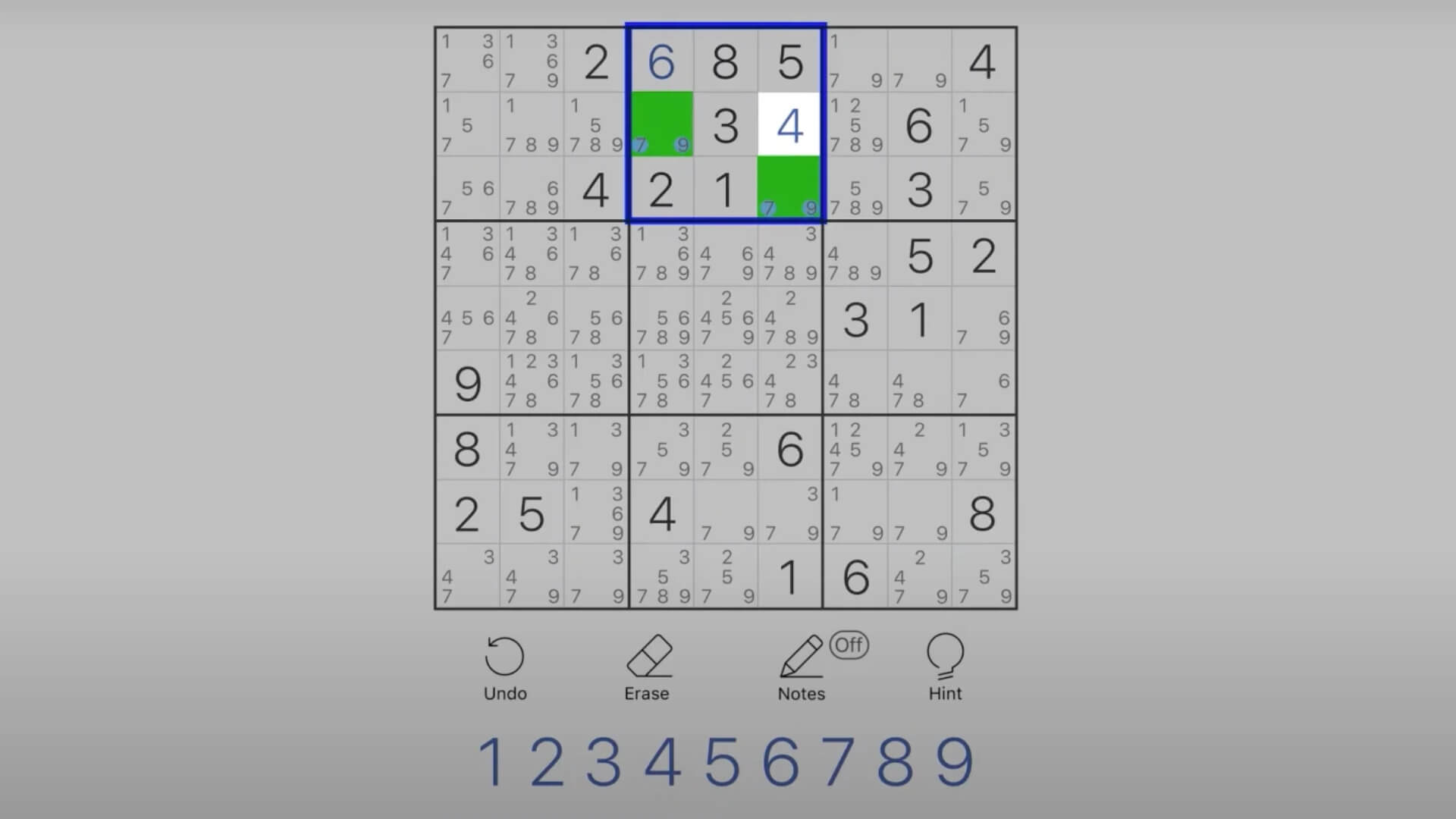
Step 3: Apply Box-Line Interactions
Use Pointing Pairs and Box-Line Reduction to eliminate candidates across block boundaries. These techniques often reveal new Direct Solves.
Step 4: Look for Fish Patterns
If simpler techniques fail, scan for X-Wing and Swordfish patterns. Start with rows, then columns.
Step 5: Try Chain Techniques
For the most challenging puzzles, employ XY-Chains and other advanced chaining methods. These require careful tracking of candidate relationships.
Practice Tips for Senior Learners
Start with Puzzles at Your Skill Level
Progress gradually from intermediate to advanced puzzles. Rushing into "Super Fiendish" puzzles can lead to frustration.
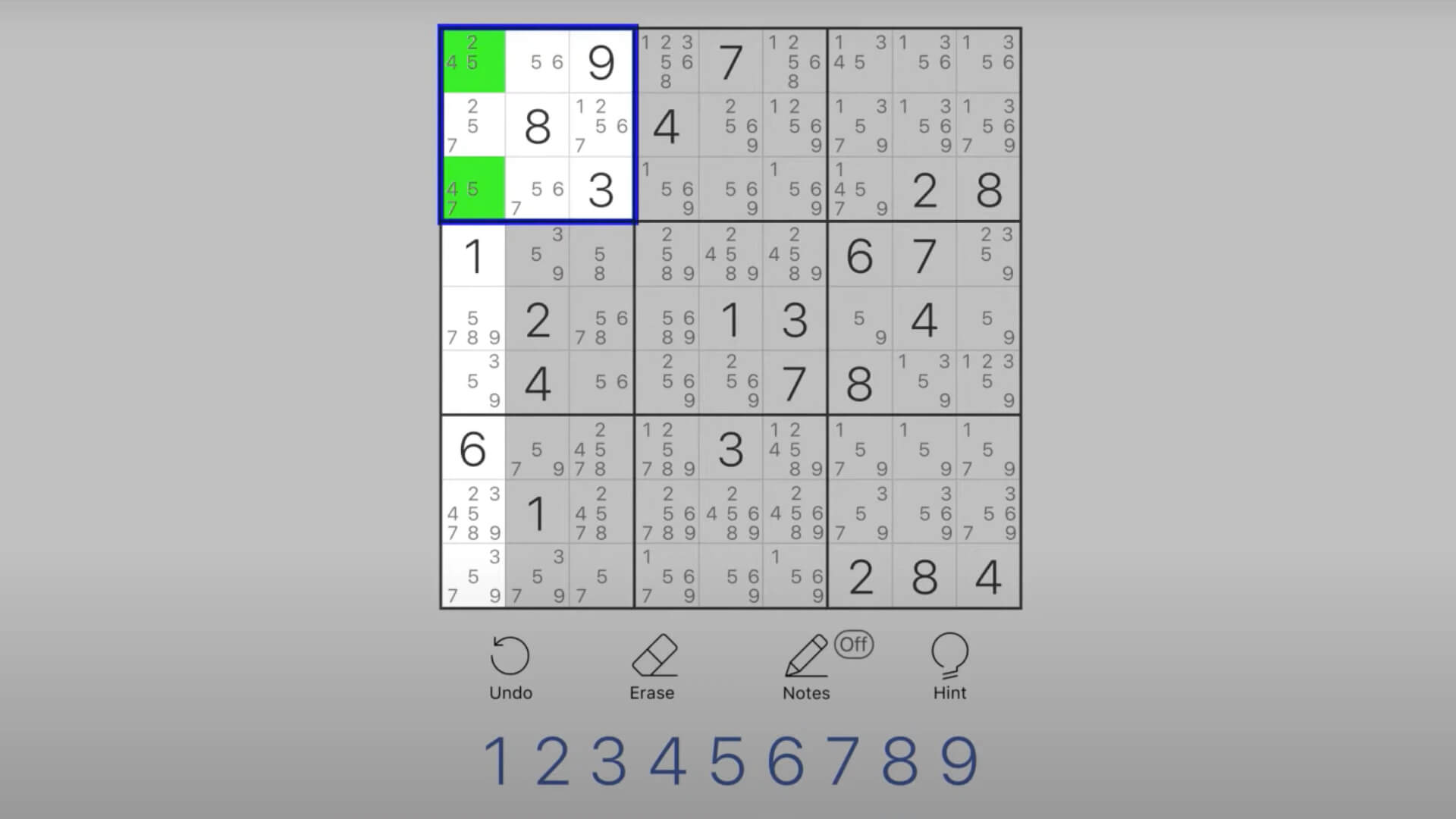
Use Pencil Marks Consistently
Maintain clear candidate lists in each cell. This is essential for recognizing patterns. Consider using different colored pencils for clarity.
Take Breaks
Sudoku solving requires mental focus. Take short breaks every 30-45 minutes to rest your eyes and refresh your mind.
Review Your Work
If you get stuck, review your candidate lists for errors. A single misplaced candidate can derail your entire solution.
Join a Community
Consider joining a local or online Sudoku club. Sharing strategies with other enthusiasts enhances learning and makes the hobby more enjoyable.
Conclusion: Embracing the Challenge
Mastering advanced Sudoku deduction techniques is a rewarding mental journey. Each puzzle solved represents a victory for your cognitive health and logical reasoning skills.
Remember, the goal is not speed but precision. Take your time, enjoy the process, and celebrate each breakthrough. With patience and practice, you'll find yourself solving puzzles you once thought impossible.
So grab your pencil and grid—your next mental adventure awaits!
Related Blogs

How to Choose the Best Health Insurance Plan in 2026: A Complete Buyer's Guide
Jun 30, 2026

HMO vs PPO vs EPO: Which Health Insurance Network Is Right for You?
Jun 28, 2026

Understanding Health Insurance Deductibles, Copays, and Out-of-Pocket Maximums
Jun 26, 2026

Best Health Insurance Plans for Self-Employed Professionals in 2026
Jun 24, 2026

What Data Do Companies Collect
Jun 23, 2026

Family Health Insurance: How to Cover Everyone Without Breaking the Bank
Jun 22, 2026

How Auto Insurance Premiums Are Calculated: Factors That Affect Your Rate in 2026
Jun 20, 2026

How to Download Apps Safely from Stores: A Complete Security Guide
Jun 19, 2026

Comprehensive vs Collision Auto Insurance: What's the Difference?
Jun 18, 2026

How to Spot Fake Websites: A Complete Guide to Protecting Yourself Online
Jun 16, 2026